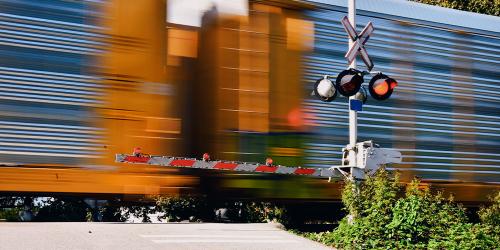
Canada has the fifth-largest rail transportation system in the world, including approximately 14,000 public and 9,000 private railway crossings along 40,000 km of federally regulated tracks. In Alberta, rail traffic includes freight trains operated by companies such as Canadian National Railway, passenger trains operated by VIA Rail and commuter trains such as the Edmonton LRT and the Calgary CTrain.
Although rail transport is heavily regulated and the subject of extensive programs and policies to ensure safe operation, accidents do occur. The Transportation Safety Board reports that across the country, there were 167 railway crossing accidents in 2024, resulting in 12 fatalities and 24 serious injuries. Of these collisions, 35 occurred in Alberta, with 2 fatalities and 8 serious injuries.
Railway crossing accidents in Canada are also reported to be trending upward. Since the start of 2026, there have been at least two reported collisions between vehicles and cargo trains in Alberta, including one in which a woman was transported to the hospital with serious injuries. Media reports also attest to several collisions in recent years with Edmonton LRT trains (see here and here) and with Calgary CTrains.
The injuries sustained from vehicle-train collisions can be severe and may include spinal cord injuries, amputations, traumatic brain injuries and organ damage. Less severe, but still impactful injuries can include broken bones, whiplash, concussions, burns and lasting emotional distress.
Common Causes of Train-Vehicle Accidents
Train-vehicle collisions can be caused by multiple factors, including:
Driver-Related Factors
Distracted driving, disobeying crossing signals and speeding are common causes of train-vehicle collisions. Reports of recent collisions with LRT trains indicate the incidents likely resulted from vehicle drivers failing to follow traffic indicators. Both fatalities from vehicle and cargo train collisions in Alberta in 2023 were linked to a failure to obey crossing signals.
Distracted driving in general is a particular concern in the province, as Alberta leads the country in fatalities from distracted driving and the province saw 10,000 distracted driving convictions in the province in 2025.
Train Conductor-Related Factors
Excessive speed can increase how long it takes a train to come to a stop and avoid a collision. Train conductors who fail to keep a proper lookout or do not decrease speed in response to signs of the potential for a collision may be at least partially liable for injuries caused to victims of a resulting accident. In addition, the drivers’ employer may be held vicariously liable for the actions of their employee.
For example, in O’Connor v. Mahabir, 2002 ABCA 13, the CTrain operator and the City of Calgary were found 25% liable for injuries suffered by a plaintiff who stepped in front of a CTrain. Although the plaintiff, who was inebriated at the time, was found to be largely the author of his own misfortune, the Court found that the CTrain driver “should have averted to the risk of passengers crossing the track without regard to their own risk” since he knew that there were pedestrians on the side of the track, and he acknowledged that “99 percent of the people do not obey the traffic signals and the gates”.
Environmental Factors
Poor visibility and dangerous road conditions due to weather such as snow and ice can make it difficult for drivers to see crossing signs or to adequately slow or stop when approaching a crossing, contributing to collisions.
Railway and Infrastructure Issues
Malfunctioning crossing signals, inadequate warning systems or poor maintenance of crossings. Obstruction of crossing signals, for example by trees or shrubs can also contribute to collisions.
Vehicle Malfunction
Any mechanical failure in the train carries the risk of serious accidents. For this reason, rail operators have a duty to conduct regular inspections and take other precautions in order to identify hazards before they lead to serious injuries or loss of life.
Mechanical issues in vehicles crossing the path of the train can also be a factor. For example, a driver may experience brake failure, or may stall or get stuck on the tracks.
In many cases, train-vehicle collisions result from a combination of these factors. For example, in a tragic 2013 collision between a bus and a VIA Rail train in Ottawa, which resulted in six fatalities and multiple severe injuries, there were several contributing factors. The investigation by the Transportation Safety Board of Canada identified distracted driving, speed of the train and visibility issues caused by trees and shrubs near the crossing as the likely causes of the accident.
Who May be Liable in a Vehicle-Train Accident?
Because these collisions often involve multiple contributing factors, liability may be shared among multiple parties.
The vehicle driver could be negligent in multiple ways, including:
- Speeding;
- Distracted driving, for example, texting and driving;
- Not obeying crossing signals; or
- Driving under the influence of drugs or alcohol.
Similarly, the train conductor and their employer could be liable for:
- Excessive speed;
- Failing to keep a lookout;
- Other forms of negligence in operation of the train.
A rail operator or railway company may be negligent in their duties to:
- Install and maintain automatic warning systems and railway crossing signs at crossings;
- Ensure there is no obstruction of these systems or signs, for example by trees or shrubs (this can also be the responsibility of municipal and provincial governments).
A government body could be negligent in their duties to:
- Properly maintain roads near crossings;
- Perform inspections and enforce safety standards.
Vehicle Accident Insurance in Alberta
If you have been involved in a train-vehicle collision it is important to understand your insurance and compensation options. In Alberta, vehicle insurance is privatized, however, insurers are required to provide a minimum level of coverage which is set out in a standardized policy known as the Standard Owner’s Automobile Policy, Form (SPF No.1). Additional coverage can be purchased on top of this minimum protection.
The standard policy includes “no fault” accident benefits under Section B. This means that you receive coverage regardless of who was at fault in an accident. Section B benefits include coverage for reasonable medical expenses up to $50,000 per person (subject to limits), wage loss replacement for certain injuries, and death, grief counselling and funeral benefits, among others.
Please see our article “What to know about Section B-Accident Benefits (No-fault Benefits)” for full details on Section B benefits.
In addition to these no-fault benefits, further compensation can be pursued through legal action against negligent parties who may have caused or contributed to the accident. This could help you recover further compensatory damages including:
- General damages: can include damages for physical, emotional and psychological injuries;
- Loss of earnings and future potential earnings: which were as a result of the accident;
- Property damage: costs associated with vehicle repairs or replacement;
- Out of pocket expenses: can include costs for medication, transportation to medical appointments and home modifications, for example.
It is important to note that both avenues of compensation can be pursued at the same time.
You can also see our previous articles on how a personal injury claim works and how to file a personal injury claim for further information on pursuing personal injury claims.
A Note About Passengers of Vehicle-Train Accidents
As a passenger of a vehicle involved in a vehicle-train accident, you are still able to recover compensation through the Section B benefits of the driver of the vehicle. You may also have a claim against the driver of the vehicle or other responsible parties, depending on the facts of the collision. Consultation with a personal injury lawyer can help you better understand who may bear liability for your injuries.
As a general rule, public carriers owe a heightened duty of care to their passengers. In the context of bus accidents, courts have indicated that the usual burden of proof is reversed, such that instead of the plaintiff having the onus to prove negligence, a defendant who is a public carrier will bear the burden of proving that the carrier was being operated in a skillful and prudent manner.
For more information about claims advanced by passengers and who may be liable, see our previous blogs addressing Injuries to Bus Passengers – Know Your Rights and Injuries to School Bus Riders – What You Need to Know.
What to Do if You’ve been Involved in a Vehicle-Train accident
- Do not leave the scene of the accident;
- If you’re able, get yourself and your passengers out of your vehicle and to a position of safety;
- Call for any medical assistance necessary
- Record the contact information of all potential witnesses to the accident and, if safe to do so, take photos of the scene;
- Reach out to an experienced personal injury lawyer as soon as possible, so that steps may be taken to protect your rights.
Do not give statements to anyone, including your own insurance company, until you have consulted a personal injury lawyer.
If you or someone you know has been involved in a vehicle-train accident, the experienced lawyers at CAM LLP can help. We are always happy to talk to injured people about their claims whether they end up needing us or not. We believe in giving people all the information they need to make informed decisions about their options. Contact us for a free consultation.